 Reviews

 Proudly American

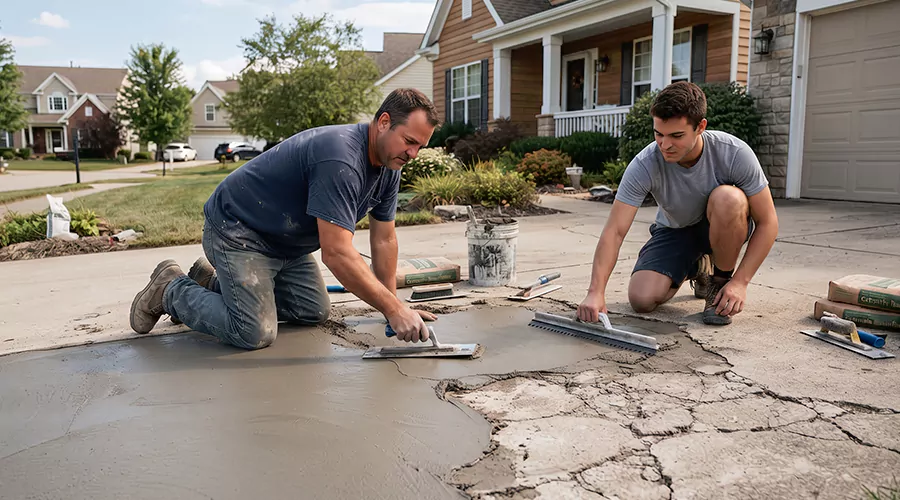
Yes, cracked concrete can often be resurfaced when the cracks are small and stable and the underlying slab remains structurally sound. Mold and drywall repair is a separate concern and may be needed when moisture-related damage affects nearby walls or drywall. Resurfacing is not a structural repair. Cracks caused by settlement or heaving can return through a new overlay unless the movement problem is corrected first.
The key question is not simply whether concrete has cracks. You need to determine why the cracks formed and whether the two sides of the slab are still moving.
What Types of Cracks Can Usually Be Resurfaced?
Small surface cracks are often good candidates for resurfacing when they have stopped moving and the surrounding concrete remains solid. Hairline shrinkage cracks or light crazing can usually be repaired during surface preparation before the new overlay is applied.
Good candidates commonly include:
- Hairline shrinkage cracks
- Fine stable surface cracks
- Light scaling around intact concrete
- Small patched areas
- Worn or discolored surfaces
Concrete patio resurfacing is especially practical when an older patio looks rough but still sits level. The crack should be repaired first rather than hidden under the new coating.
When Should Cracked Concrete Not Be Resurfaced?
Resurfacing is a poor choice when cracks show active structural movement or significant height differences. An overlay follows the slab underneath it. It cannot stop settlement or correct a failed base.
Warning conditions include:
- One side of a crack sits higher than the other.
- The crack continues to widen.
- Sections of concrete are sinking.
- The slab rocks under weight.
- Large pieces are breaking away.
- Water repeatedly enters beneath the slab.
- Several repaired cracks keep reopening.
- The base appears washed out or unstable.
Cracks wider than about 1/8 inch deserve closer inspection before resurfacing. Width alone does not prove structural failure, but movement or vertical displacement makes resurfacing much less likely to last.
Why Do Old Cracks Come Back Through an Overlay?
Old cracks return when movement continues beneath the resurfaced layer. A new overlay is bonded to the original concrete, so movement in the base can transfer directly into the new surface. This is sometimes called reflective cracking.
| Existing Condition | Resurfacing Outlook |
|---|---|
| Hairline stable crack | Good candidate |
| Small repaired crack | Often suitable |
| Surface scaling | Often suitable |
| Growing crack | Poor candidate |
| Vertical displacement | Usually unsuitable |
| Major settlement | Replacement may be better |
Surface preparation cannot turn an unstable slab into a stable one. Concrete restoration works best when the underlying concrete can still support the new surface.
How Are Cracks Repaired Before Resurfacing?
Cracks should be cleaned and repaired before an overlay is installed. The surrounding concrete also needs proper surface preparation so the resurfacing material can bond to solid material rather than dirt or weak surface paste.
A typical preparation sequence is:
- Clean the slab thoroughly.
- Remove loose or weak concrete.
- Open or prepare cracks when required.
- Fill suitable stable cracks with a compatible repair material.
- Mechanically profile the surface when needed.
- Remove remaining dust.
- Apply the resurfacing system as directed.
Skipping preparation is one of the fastest ways to shorten overlay life. Covering a dirty or poorly bonded slab can lead to peeling even when the cracks themselves were minor.
How Much Does It Cost to Resurface Cracked Concrete?
Basic resurfacing commonly costs about $3 to $5 per square foot in 2026 when the slab needs normal preparation. Crack repairs can add to the total. Full replacement averages much more because demolition and a new slab are required.
| Work | Typical 2026 Planning Cost |
|---|---|
| Basic resurfacing | $3 to $5 per sq. ft. |
| Concrete repair | Around $4 per sq. ft. |
| Extensive surface repair | Can approach $9 per sq. ft. |
| Full replacement | Around $10 per sq. ft. on average |
Concrete resurfacing cost becomes less attractive when extensive repairs bring the project close to replacement pricing. A structurally sound slab with mainly cosmetic damage creates the strongest financial case for resurfacing.
How Can You Check Whether a Crack Is Still Moving?
A simple crack-monitoring test can help identify movement before money is spent on a new surface. Clean the area and photograph the crack with a ruler beside it. Mark the ends so changes are easier to notice.
Follow these steps:
- Measure the crack at its widest point.
- Photograph the same location.
- Mark both ends with removable chalk.
- Check it again after several weeks.
- Repeat after major weather changes.
Also run your fingers across the crack. A noticeable height difference between the two sides is more concerning than a thin crack with both sides at the same level.
When Should You Call a Professional?
Professional assessment makes sense when the crack is widening or has vertical displacement. Repeated cracking after previous repairs can also point to movement below the slab. An evaluation can determine whether crack repair is enough or whether the base needs correction first.
Consider professional assessment when:
- Cracks continue getting longer.
- One side of the slab has dropped.
- Several sections are uneven.
- Large cracks repeatedly reopen.
- The slab is next to a structural foundation.
- Drainage problems are washing out the base.
Patio restoration should not begin until the reason for major movement is understood. Applying another surface over a failing slab can turn one repair into two.
How Can You Help Resurfaced Concrete Last Longer?
Resurfaced concrete lasts longer when water drains away and small damage is addressed before it spreads. Cleaning also prevents dirt from building up on the finish. Many resurfaced surfaces benefit from periodic sealing based on the coating system and exposure.
Use this maintenance routine:
- Sweep debris as needed.
- Wash the surface when dirt builds up.
- Inspect cracks twice a year.
- Correct drainage problems promptly.
- Repair new stable cracks early.
- Reseal as the coating system requires.
Avoid letting water collect along crack lines. Repeated moisture can contribute to deterioration around weak areas.
Conclusion
Cracked concrete can be resurfaced when the cracks are stable and the original slab remains structurally sound. Hairline cracks or light surface damage can often be repaired before an overlay is applied. Resurfacing should not be used to hide active settlement or vertical movement. If a crack is growing or one side is higher, have the slab evaluated before investing in a new surface.
Frequently Asked Questions
Can you resurface concrete with hairline cracks?
Yes. Hairline cracks can often be repaired during preparation when the slab remains stable.
Will cracks show through resurfaced concrete?
They can. Active cracks can transfer through the overlay if movement continues underneath.
Is resurfacing cheaper than replacing concrete?
Usually. Basic resurfacing is often around $3 to $5 per square foot while replacement costs more because the old slab must be removed.
Can a cracked concrete patio be resurfaced?
Yes, when the patio is level and the cracks are stable. Settlement or heaving should be corrected first.
How wide can a crack be before resurfacing becomes a problem?
There is no single width that decides the answer. Cracks over about 1/8 inch deserve closer evaluation, especially when they are growing or displaced.
Can resurfacing fix sinking concrete?
No. Resurfacing changes the surface but does not lift or stabilize a sinking slab.